
Extracellular matrix fragmentation in young, healthy cartilaginous tissues

1 Division of Cell Matrix Biology and Regenerative Medicine, Faculty of Biology Medicine and Health, The University of Manchester, Oxford Road, Manchester, M13 9PT, UK
2 Biological Atomic Force Microscopy Facility, Faculty of Biology Medicine and Health, The University of Manchester, Oxford Road, Manchester, M13 9PT, UK
3 School of Materials, Faculty of Engineering and Physical Sciences, University of Manchester, Oxford Road, Manchester, M13 9PL, UK
4 School of Mathematics, Faculty of Engineering and Physical Sciences, University of Manchester, Oxford Road, Manchester, M13 9PL, UK
5 NIHR Manchester Biomedical Research Centre, Central Manchester University Hospitals NHS Foundation Trust, Manchester Academic Health Science Centre, Grafton St, M13 9WU Manchester, UK
Abstract
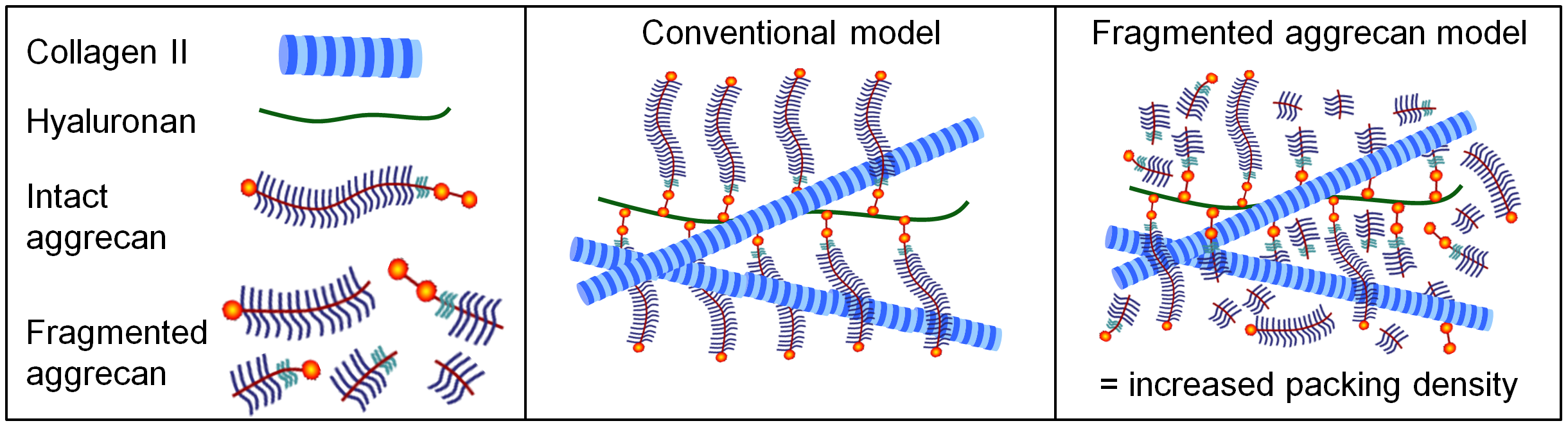
Although the composition and structure of cartilaginous tissues is complex, collagen II fibrils and aggrecan are the most abundant assemblies in both articular cartilage (AC) and the nucleus pulposus (NP) of the intervertebral disc (IVD). Whilst structural heterogeneity of intact aggrecan ( containing three globular domains) is well characterised, the extent of aggrecan fragmentation in healthy tissues is poorly defined. Using young, yet skeletally mature (18-30 months), bovine AC and NP tissues, it was shown that, whilst the ultrastructure of intact aggrecan was tissue-dependent, most molecules (AC: 95 %; NP: 99.5 %) were fragmented (lacking one or more globular domains). Fragments were significantly smaller and more structurally heterogeneous in the NP compared with the AC (molecular area; AC: 8543 nm 2 ; NP: 4625 nm 2 ; p < 0.0001). In contrast, fibrillar collagen appeared structurally intact and tissue-invariant. Molecular fragmentation is considered indicative of a pathology; however, these young, skeletally mature tissues were histologically and mechanically (reduced modulus: AC: ≈ 500 kPa; NP: ≈ 80 kPa) comparable to healthy tissues and devoid of notable gelatinase activity (compared with rat dermis). As aggrecan fragmentation was prevalent in neonatal bovine AC (99.5 % fragmented, molecular area: 5137 nm 2 ) as compared with mature AC (95.0 % fragmented, molecular area: 8667 nm 2 ), it was hypothesised that targeted proteolysis might be an adaptive process that modified aggrecan packing (as simulated computationally) and, hence, tissue charge density, mechanical properties and porosity. These observations provided a baseline against which pathological and/or age-related fragmentation of aggrecan could be assessed and suggested that new strategies might be required to engineer constructs that mimic the mechanical properties of native cartilaginous tissues.
Graphical Abstract
Keywords
- Cartilage
- intervertebral disc
- extracellular matrix
- aggrecan
- glycosaminoglycans
- protein structure
- protein homeostasis
- nanomechanics
- structural biology
Cite
Share
Top